
In An Editor's Mind
Things I think about while reading...with some tips and links to even more tips; another in my series: An Editor's Tips for Writers

People assume that editors always focus on looking for typos, misspelled words, and misused punctuation, but a content editor like myself is looking at the big picture—the story’s central arc and the main characters’ individual arcs, among other things—and I’m only concerned with an author’s global style issues, in other words, the writing quirks and challenges that recur throughout their manuscript.
Another common assumption is that an editor will spot more of these issues in self-published books than in book from The Big Five and the major mid-list publishers. That is no longer true. I may catch more problems in a self-published work, but the traditional houses are doing less and less content and line editing, so that issues like repetition, obvious expository, and even poor word choices are slipping past over-worked copyeditors—who are, after all, chiefly hired to polish and perfect the words on the page.
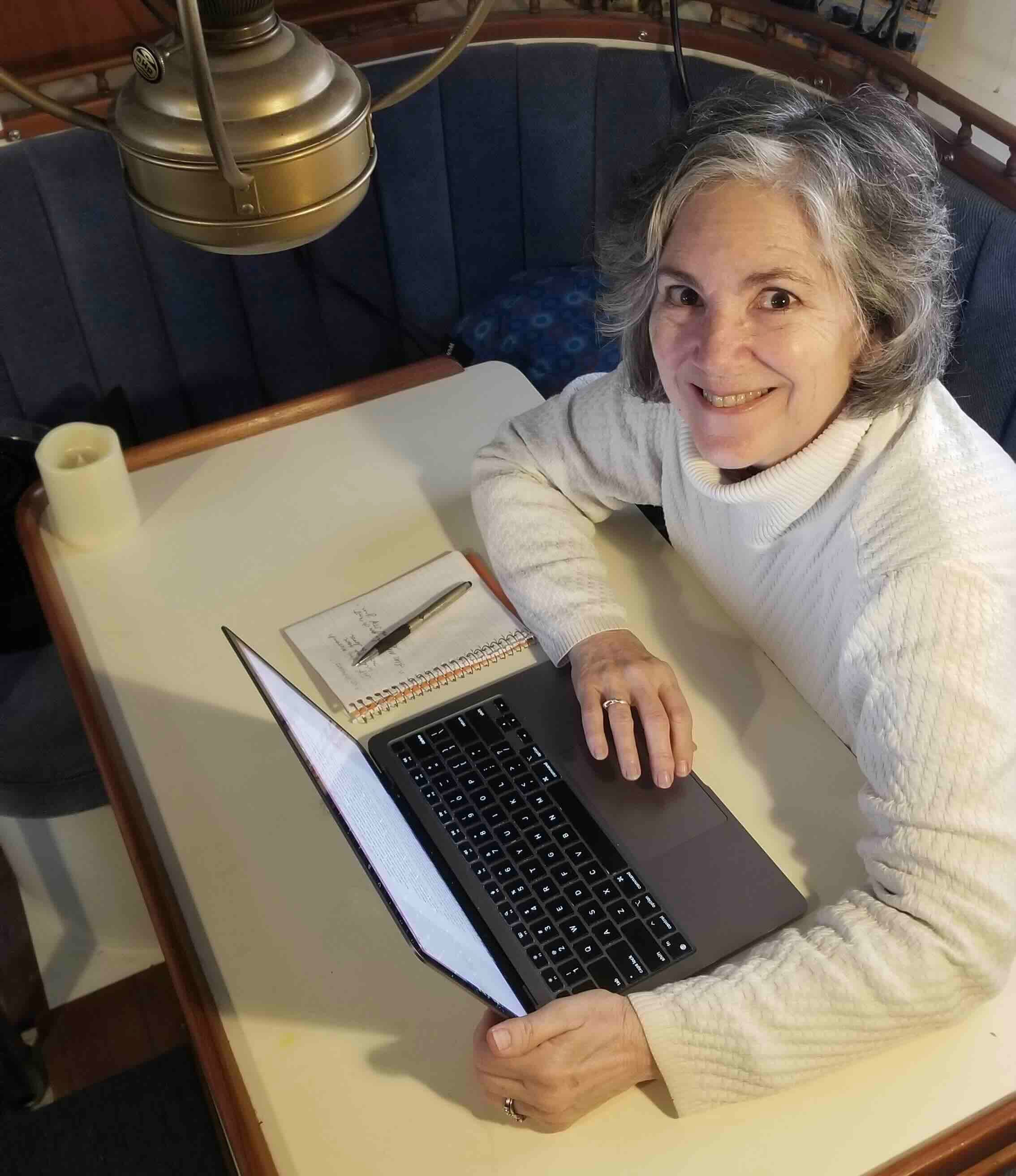
A not-very-recent photo of this editor, at work aboard Watchfire.
I enjoyed The Invisible Hour (Atria Books, August 2023) by Alice Hoffman, and she's obviously a fine writer, but there was a great deal of repetition in the book. I get it—Alice Hoffman is a big name and what editor wants to say "You've already told us what happened that night, do you really need to tell us again?"
Maybe the author and editor thought the events needed to be reiterated (they didn't) and then repeated almost word for word again in the courtroom scene (really?). That was truly irritating to me, but one can imagine it slipping by a casual reader, since the iterations were many chapters apart.
But when I came across this sentence in the book, it went clunk clunk clunk in my brain:
"He felt as if a spell had been cast as they began to walk along together, and he felt transported."
First "he felt as if a spell had been cast" as they walked, and then he "felt transported"? Then maybe after that he felt really happy? Ugh.
I would suggest: "As they began to walk along together, it was as if a spell had been cast—he was transported."
You could use "he felt transported" if you preferred, but—unless you're writing sci-fi—your readers will know that the character wasn't actually transported, so you don't need to worry.
I always tell authors to try to replace the filter words (like felt/feel, saw, looked) when they are rewriting. But if you do opt to write "she felt such-and-such," please don't use it twice in the same sentence. Readers may not be able to say why it bothers them, or even be aware that it does bother them, but I’d bet that, subconsciously, it will go clunk.
I was reading an ARC this week from one of the best hybrid houses out there and was only a few pages into it when a married couple (who clearly lived together and were quite friendly) started telling each other about their three children as if they were strangers on an airplane. I get that parents might talk about their kids' past problems, but why would they take turns talking about each child like their spouse had amnesia?
It's clunky obvious expository writing and lazy—or possibly non-existent—content or line editing. To be clear, content editing comes first, so the section could have been flagged for the author to address in the first editing pass, but for sure, it should have been caught in the line editing, so I'm assuming that pass never happened.
And again, it is not within the purview of most copyeditors to make substantial multi-page edits with notes like, "Author: Please rewrite this section to read like actual dialogue between two characters who have been co-parenting their children for many years," but even so it should have warranted at least a comment.
So, that's the kind of things an editor spots while reading for her own pleasure (this post lists a few other things that bug me). And yes, I also noticed a few dozen pointless commas in all three books (see my previous post that includes a tip on how to avoid that problem). Imagine how many more problematic issues I can catch when I'm being paid to edit the book.
Luckily, most of the clients I'm working with right now are either creating second or third books in a series or are working on their second or third novel with me, so we have already been through the editing-process-learning-curve together. Not that these authors don't still leave some structural problems for me to catch—they’re human, after all.
Seriously, no one that I know can spot all the errors in their own work—I sure can’t. Just ask either of my two brothers who generously took the time to read Honeymoon at Sea in its final galley form (this was after the publisher's editor, copyeditor, and proofreader thought they were done with it) and they caught plenty of errors. I think about that last-minute rescue with gratitude every time I read a great review of my book.
Editing should be central to the process of publication, and it isn’t just about typos and misspellings.
Hasta pronto!
I used to edit textbooks: not like novels, not editing for content. Just simple stuff like grammar, making sure edits haven’t made the end-of-chapter questions impossible to answer, stuff like that. Easy. It’s astounding how many aspects of book production authors are totally in the dark about. Seriously, pay a professional! You may know your subject better than anybody, but that doesn’t mean you know the book biz.
So good to read (and forward to some who need it) the role of the developmental or content editor. I am so grateful you reviewed my manuscript, cleaned it up, made such great suggestions and overall, made it so much better. Let's do it again.