
Editing Tips: Misplaced Verbs and Prepositions
Another in my series: An Editor's Tips for Writers

I read a lot of books and manuscripts each year, so I see a lot of the same mistakes over and over (not “over and over, again”). One is the overuse of the verb “start” or “begin” (and the phrases “started to” and “began to”) and the other is the use of prepositions like “toward” where they are not needed.
The phrase “started to” can be used when what is started is ongoing, such as “He turned back to the computer and started answering his morning emails,” but “started to” is even more effective when that action is somehow halted or delayed—”She started to answer him but was seized by a coughing fit.”
What I see too often is the word start (or begin) or the phrase started to (or began to) being used for a brief action, so that the words are no longer useful and can even be confusing. “She started to open the door” only works if she couldn’t complete the action. Otherwise, use “She opened the door” or, if the preparation for the action needs to be slower for some reason, “She reached for the doorknob.”
Recently, I was reading a fine book, The Flightless Birds of New Hope, out from Lake Union Publishing, which I definitely recommend. Anyway, I came across this line:
“Then he trudged down the hallway, toward the bathroom, to brush his teeth.”
Why toward? There’s no further mention of the bathroom so we are left to assume he reached the room and achieved the tooth-brushing, so why not “Then he trudged down the hallway to the bathroom to brush his teeth.”? That way, you can take out the commas—which were nearly useless anyway—and tighten it up. I would probably rewrite it: “Then he trudged down the hall to the bathroom and brushed his teeth.” (Don’t use hall as shorthand for hallway when there’s any chance of mistaking it for a hall in the sense of a meeting place, like “She walked straight from the hotel lobby over to the hall.”)
Don’t have your characters start to do things, or go toward places. Have them perform the action, and get to the place. Otherwise, you end up having to overwrite simple things like this: “Then he trudged down the hallway, toward the bathroom, to brush his teeth. Having brushed his teeth, he went to bed.” (No, the book didn’t include this coda, the text went into the character’s head—perhaps he was thinking while brushing—but the manuscript might well have; maybe it was caught by a sharp-eyed editor.)
As usual, I spotted a few pointless commas in recent books, and I highlighted them to use as examples for you.
In the same book, I caught this example: “The shadows carved deep hollows beneath her eyes—angry, purple bruises that spoke of sleepless nights…” By now, my faithful readers all know that the comma in that line is superfluous, because “angry” is modifying “purple bruises” not just bruises. The test that proves it is replacing the comma with an “and”—angry and purple bruises” anyone?—or switching the adjectives to make it “purple and angry bruises,” which definitely hurts my ears.
I am sure that Lake Union Publishing employs fine copyeditors, but no one catches everything in a single copyediting pass, which is all that most publishers will pay for. If the author had eliminated them while rewriting, there would be no problems.
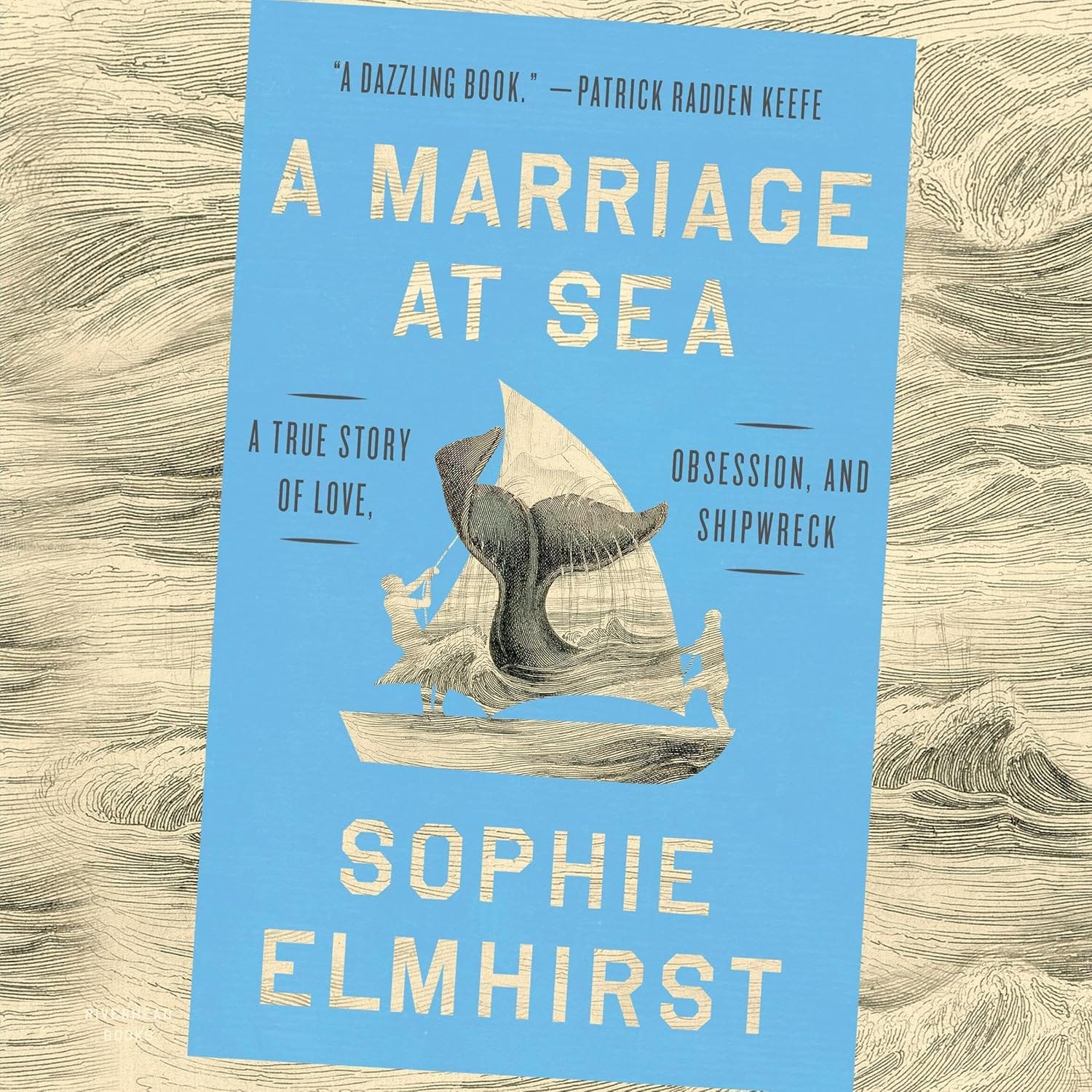
I spotted the same issue here, in A Marriage at Sea, which I have just started reading: “In the evenings, he returned home to a cramped flat on Rose Hill Street, a thin road of squat, redbrick houses near the centre of the city.” We can see that “squat and redbrick houses” doesn’t work and neither does “redbrick, squat houses.” They are “squat redbrick houses” just as other people live in “tall wooden houses” or “low adobe houses.”
Another pet peeve is misplaced modifiers. In the wonderful book Move Like Water, which I reviewed) the sailors were “handing cups of tea up from the galley, which overflowed with rain almost the instant they were on deck.” This makes it sound like the galley overflowed once it was on deck, when it was clearly the cups she was referring to. I would have written it as: “handing up from the galley cups of tea, which overflowed with rain almost the instant they were on deck.”
This error of modifiers is somewhat like a dangling participle, and if you don’t recall your high school English class, participles are said to “dangle” when there’s no subject included, like this: “Writing for an hour, the Substack was finally finished.”
For the new subscribers here—33 just last month and another two just since Dec 1— you might be interested in pieces I’ve written about other things that jump out at me (this post lists a few things that bug me). I also wrote a couple of posts about what I do, which is content editing; I went a bit deeper on that subject here.
I spent this week in a lovely home, dog-sitting for two rambunctious but loving canines (it has been rainy, so this meant a lot of paw-washing and toweling them off!) The house is already decorated for the holidays to the utmost, inside and out, which is fun; being surrounded by colorful Xmas lights and cheery holiday decor has put me in the spirit much earlier than usual (I tend to be more like, “wait, it’s this week?”).
Yesterday I was live on Substack, talking about travel and life with Alicia Dara of Womancake Magazine which was very fun. (I had a hard time getting my phone to balance just right…gotta get a phone stand for this, I guess). You can see our conversation here. I also got to meet with my writers circle writer group and to chat with some other author friends online this last week, which is always a joy.
Speaking of books and authors, here is an upcoming San Diego book event:
Join my friend Jill Hall at the Point Loma/Hervey Library this Monday, Dec 8 at 6:30. The library has a perfect event space and it’s so very important that we support our neighborhood libraries and our local authors. Jill will share archival photos and speak about researching/writing On a Sundown Sea: A Novel of Madame Tingley and the Origins of Lomaland (which I loved and reviewed here). You can support your local bookstore too: La Playa Books will provide copies for the author to sign. Jill’s site is here.
Next week I will be revealing my Favorite Books of 2025 list.
hasta pronto!
Always love your tips, Jennifer. Always makes me want to pull up my last post and make sure I didn't make that mistake ): I have to be careful with overuse of commas. So a good reminder for sure.
More good advice. Thanks!